Collaroy Rock Pool (South Collaroy Rock Pool)
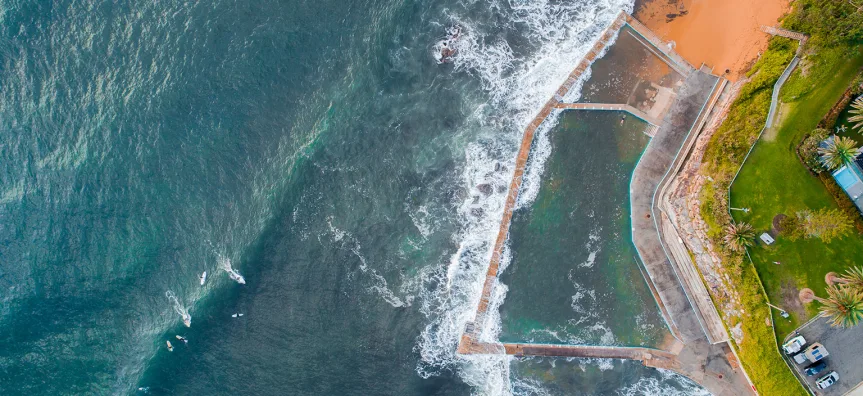
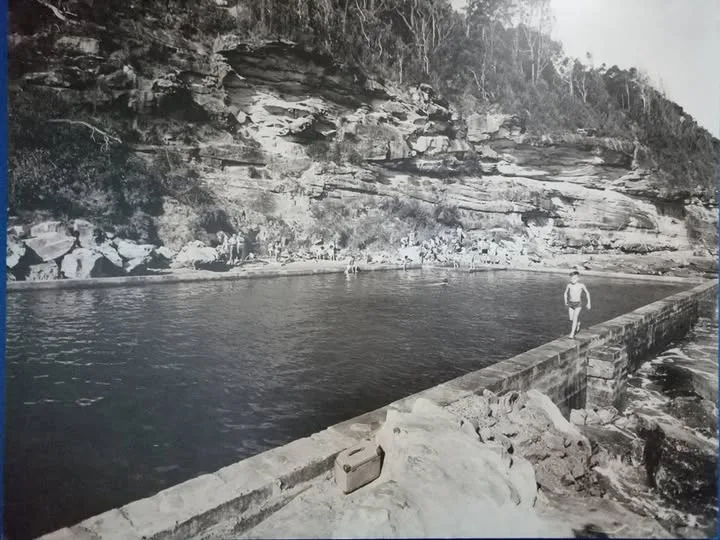
Sited at the southern end of Collaroy Beach. A classic ocean pool with chains. Pool complex of two interconnecting pools, namely a 50-metre pool and a smaller wading pool. Both irregularly shaped and sited to follow the curve of the nearby low-level rock face. Concrete promenade. This pool is a popular subject for photographers.
Click to find location on AllSwims.au
Do you have a good photo we can use here? Please email us: allswims.au@yahoo.com
See also
Historical notes
The Salvation Army inherited 500 acres at Collaroy from a settler family.
The area, the beach and a local street were named after the iron paddle steamer, PS Collaroy, stranded near the site of the rock pool in 1881.
1906 Warringah Shire was formed.
1919 A young man was taken by a shark just off the Collaroy Rock Pool.
Early 1920s An early rock pool appeared on the Collaroy estate subdivision plan.
1926 The ocean pool constructed for Warringah Shire by Arthur Larkin officially opened.
1935 The Collaroy Progress Association submitted a plan for a proposed extension to the rock pool, requesting Council to obtain a loan under the Unemployment Relief Scheme for the pool. Tenders were called in May.
At a Tourist Development Conference in Newcastle, real estate agent Henry F. Halloran praised Warringah Shire’s investment of 225 pounds in improvements to the Collaroy Rock Baths. He saw the rock baths as adding to the attractions of the surf beach, encouraging more people to visit and attracting potential permanent residents.
1937 Work to deepen the rock pool and extend its length to 55 yards was completed under the Unemployment Relief Scheme. A women’s Amateur Swimming Club re-formed and used Collaroy’s rock pool for its carnivals. The Club’s membership grew rapidly and averaged around 175 members annually until the 1970s. Club events were held on Saturday afternoons, long-distance events on Wednesday evenings, plus carnivals and social events.
1944 & 1945 The Northern Suburbs Women’s Amateur Swimming Association formed. It involved ladies clubs at Collaroy, Dee Why, Freshwater, Manly and Narrabeen ocean pools.
On October 3 1945, the Collaroy (Men’s) Amateur Swimming Club had its first Annual General Meeting. The meeting acknowledged the assistance that the Collaroy Women’s Amateur Swimming Club and the Collaroy Surf Life Saving Club had provided to their club.
The Collaroy Women’s Amateur Swimming Club and the Collaroy (Men’s) Amateur Swimming Club staged competitions at the Collaroy Pool on alternate Saturdays.
1946 to 1949
The Collaroy (Men’s) Amateur Swimming Club announced in 1946 that it would conduct Learn to Swim classes at the Collaroy Baths on Saturday mornings.
The Collaroy Women’s Amateur Swimming Club also promoted learn-to-swim campaigns that taught many children and adults at the Collaroy pool.
On 6 April 1948, the Collaroy (Men’s) Amateur Swimming Club had its last recorded meeting.
1950s Aboriginal boys and girls from inland NSW attending the annual Aboriginal Welfare Board summer camp held at the Salvation Army’s Collaroy centre were photographed swimming at the Collaroy Pool.
On 15 August 1952, the Collaroy Amateur Swimming Club reformed, with its members swimming on Sunday mornings.
The Learn to Swim campaign was a priority for Collaroy (Men’s) Amateur Swimming Club and the Collaroy Women’s Amateur Swimming Club.
Unlike the Collaroy Women’s Amateur Swimming Club, the Collaroy (Men’s) Amateur Swimming Club did not have its own clubhouse.
After a late-1950s inter-club carnival between Collaroy and Dee Why, the Collaroy (Men’s) Amateur Swimming Clubs decided to hold 2 carnivals each year with the Dee Why Club and one a year with Freshwater Club
1960s A winter swimming club, the Collaroy Crabs, was started as an adjunct to the men’s Amateur Swimming Club.
1966 The rock pool wall was reconstructed. Standard swimming pool step-ladders were installed on its northern and western walls.
1970s The Collaroy pool was enlarged, its natural rock bottom concreted, external decking laid and an electric pump installed and public toilets built. Swimmers no longer tripped over and hit their feet on the bottom. Though the main pool was 50 metres by 25 metres and the wading pool 18 metres by 10 metres, this pool with no parallel walls remained fairly impractical for swimming carnivals.
1983 Widening of the western end promenade to the pool to 2.4 metres commenced.
1985 The Collaroy pool walkway was constructed.
1994 Council approval for swimming club use of rock pools for club races specified that the public must continue to have access to a minimum of two lanes in the pool during the club races.
1997 & 1998 As vandalism and damage in the parks and reserves adjoining Collaroy Beach and its swimming pool were linked to irresponsible consumption of alcohol in those parks, Warringah Council considered declaring an alcohol-free zone in the Collaroy Central Business District.
The rock pool was refurbished to level its surrounding walkway and increase the width of its southern wall. The pool was closed to the public in June for repairs and did not re-open until November 29.
While its much-loved pool was closed, Collaroy’s unofficial Lizards Club turned to ocean swimming. Community pressure had led to re-opening of the pool in early December, before the work was complete. While some problems with the pool had still to be corrected, the improvement was marked. The Collaroy Women’s Amateur Swimming Club, which had changed its name to the Collaroy Women and Associates Swimming Club, was back at the pool in early December. As part of the 1997-98 Swim safe program conducted in council and community pools, the Collaroy Amateur Swimming Club conducting classes at the rock pool before its Sunday races.
1999 Warringah Council began monitoring water quality in this pool and its other five rock pools.
Enraged at possible disposal of the so-called Collaroy Children’s Hospital site, which had been an extraordinarily public-spirited gift, local residents proposed the building be used for children or adults with spinal injuries, who could make use of the Collaroy rock pool and its modern wheelchair facilities.
Three schools a week used the pool during the swimming season.
2000 Swimmers complained that Collaroy pool was vile, slimy and not being cleaned properly, as Warringah Council had stopped scrubbing the walls and floor of the pool and only flushed it. Warringah Council denied any decline in high-pressure cleaning of the pool, noting that a build-up of slime could occur when high tides and high seas prevented the pool from being emptied. The Council spokesman attributed the oil slick on the water surface to body fat and the oils used in the base of sunblock creams.
2001 Collaroy was an almost flawlessly clean beach according to the EPA, but locals again complained about slime on the bottom of the rock pool. Apparently, due to the level of the outlet valve, Collaroy pool was the only Warringah ocean pool that could not be cleaned by high-pressure water-blasting. Cleaning staff needed to wear waders and use brooms to ‘sweep’ the bottom.
The viewing area next to the rock pool was used by swimmers, people hung over from the previous night, travellers, walkers, runners, and dreamers attracted to the still water of the pool. One of the Collaroy Lizards had swum at Collaroy for about 54 of his 80 years.
2004 Residents objected to council staff cleaning the Collaroy rock pool with a high-pressure hose attached to a water tap, while Sydney had water restrictions. While use of a new firefighting pump meant most of the water for pool cleaning came from the ocean, Warringah’s pools were normally cleaned at low tide and it was difficult to get that pump to work at very low tide.
———
Historical data and text adapted from All into Ocean Pools Inc (originally published at allintooceanpoolsinc.org, including research contributed by Marie-Louise McDermott), retrieved via the Internet Archive’s Wayback Machine. Used under Creative Commons Attribution guidelines.
Allintooceanpoolsinc.org was a great resource which has been lost to the internet and we have restored the page content to keep it live and available. If you have updates or images related to this please contact us to add them. We also want the original authors to contact us. Thank you
Related articles
More in Rock Pools →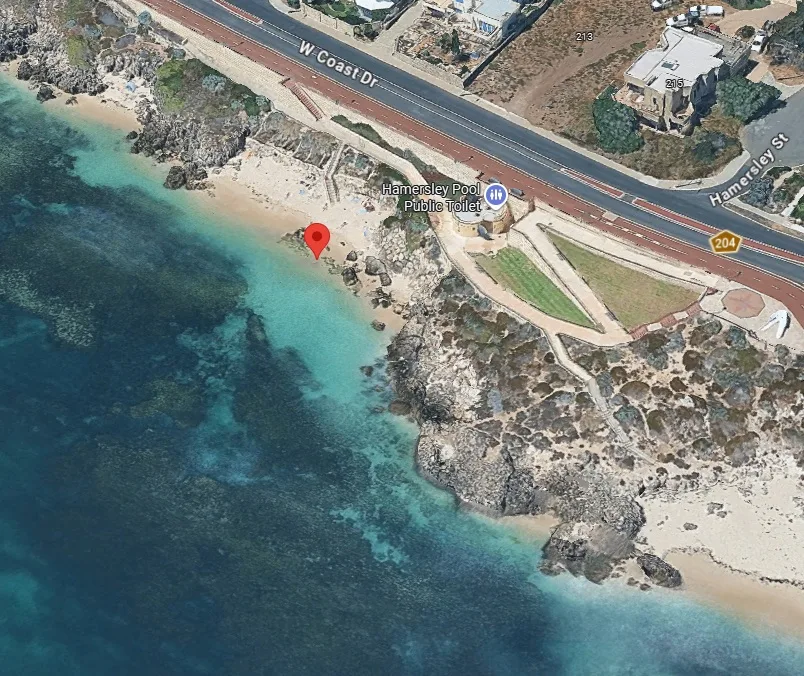
Hamersley Pool
Hamersley Pool is an informal. reef-enclosed, tidal pool recorded as attracting swimmers and bathers since the early 20th century. (Hammersley Pool, Hamersley’s Pool)
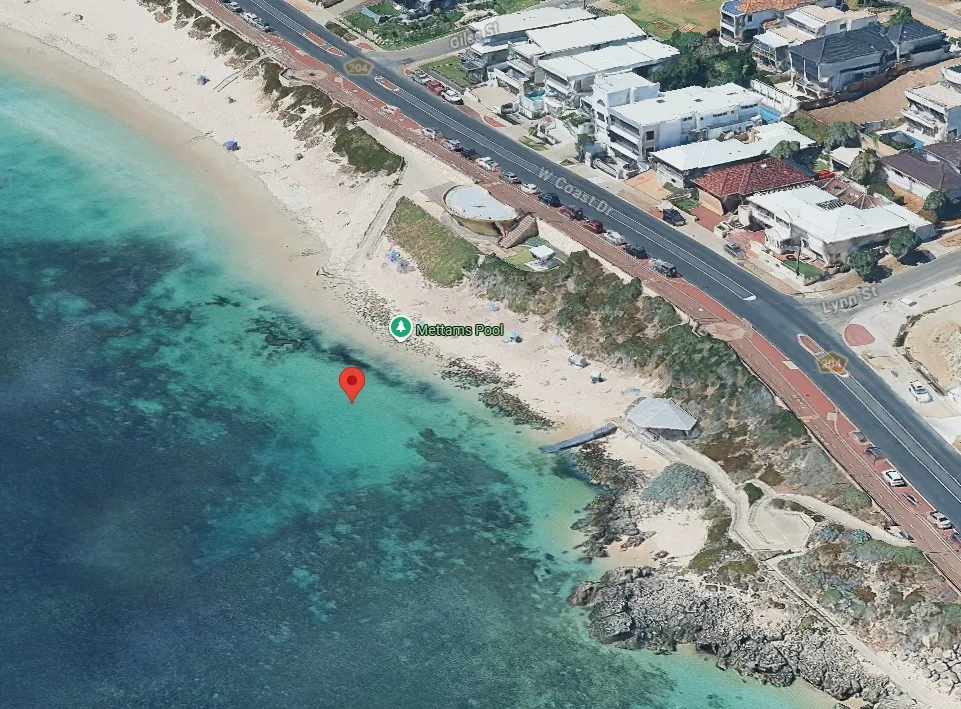
Mettams Pool
A reef shelters this large, informal, ‘improved’, ‘natural’ rock pool developed through the efforts of one man, his children and grandchildren. It has long…
Umina Beach (ghost pool)
South Umina Tidal swimming pool was beautiful with the rock face above it but mostly destroyed in storms 1974.