
Oak Park Pool
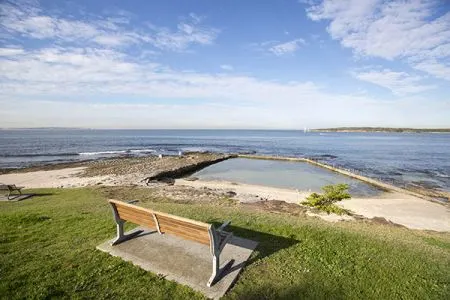
The southernmost of Cronulla’s rock pools. Located below Oak Park with its distinctive dressing-pavilion. No pumps are needed at these baths or at any of Cronulla’s other ocean baths. Linked to Cronulla’s other ocean pools by The Esplanade, a popular walking track.
Click to find location on AllSwims.au
Do you have a good photo we can use here? Please email us: allswims.au@yahoo.com
Historical notes Clans of the Dharawal people lived around North Cronulla and Cronulla Beach.
1827 Surveyor Dixon used the term ‘Cronulla beaches’.
1885 The railway reached Sutherland and the Cronulla area gained popularity as a picnic place.
1906 Sutherland Shire was proclaimed.
1907 The Oakes Reserve at Cronulla was established by the Sutherland Shire Council because of the stream located there. A well was sunk there in 1907 to serve the influx of summer visitors and residents and a natural pool existed at what is now the eastern corner of the Oak Park Pool.
1909 Residents approached Sutherland Shire Council about construction of a ‘bathing place’ and asked for a Council grant of 10 pounds to supplement 10 pounds raised by private contributions to remove some rock and form a bathing place at the Oakes Reserve. Council was unenthusiastic, believing that ‘a marine engineer with a thousand pounds’ might fail to accomplish the desired result. Despite those reservations, Council was prepared to consider providing dressing sheds at the Oakes Reserve, then considered the safest surfing beach at Cronulla.
Undeterred by Council’s lack of enthusiasm for the pool, the residents constructed their own bathing place at the Oakes Reserve
1921 Tenders were called for dressing sheds at the Oakes Reserve (soon better known as Oaks Park), owing to the popularity of the bathing place.
1922 Council produced a report on the pool idea, having instructed its overseer to report on ‘the best and cheapest method of improving the swimming hole at Oaks Park’.
1926 Council made improvements at Oaks Park (the name would soon be shortened even further) and called tenders to erect lavatories there.
1927 There were complaints that unless the partitions in the dressing-shed were fixed, there would be ‘mixed dressing as well as mixed bathing’ at Oak Park. All this at a time when Sutherland Shire Council would not allow bathers to parade or loiter on the beach clad only in their swimming costumes.
1930 By 20 December, Sutherland Shire had finished work on the Oak Park pool and it was ready for use during the holidays.
1931 The pool was completed.
1935 Council spent a thousand pounds on work at the pool. The pool was increasing in popularity and The Hurstville Propellor urged Council to consider enlarging the pool, which often became ‘uncomfortably crowded at weekends and holidays’.
1936 The baths at Oak Park benefited from the 1936 unemployment scheme devised by E. S. Spooner, the NSW Minister for Works.
Residents complained that the recently repaired Oak Park pool was leaking so badly that it was impossible to swim at low tide because the pool only held about two feet of water. There were also complaints about dogs in the pool and about men who rolled their swimming costumes down to their waists, or even worse, wore only shorts. Installing an inspector at the pool was suggested as the best way to overcome these problems.
1939 W.F. Foster and company built the Oak Park pavilion at a cost of 2,000 pounds to replace the earlier timber dressing-sheds.
1942 The Australian Army erected an observation tower mounted on the Oak Park pavilion and established a gun-post at Oak Park. The gun emplacements were camouflaged as a kiosk with bright candy stripes. The Army banned residents from bathing in Oak Park pool when the swimming season began in October. To mollify aggrieved residents, a conference was arranged with one of the Army men responsible, Colonel Hurst, and the matter was taken up with the Federal Member for the district, Mr H. B. Lazzarini, MHR. Residents were told ‘this action was taken in the interests of Australia as the end of the war was not in sight’.
1980s Rising public liability costs threatened the survival of all Cronulla’s tidal pools.
There were complaints about dogs swimming in the Oak Park pool.
1993 Questions were asked in the NSW parliament about the inordinate time Sutherland Shire seemed to take to repair leaks in the Oak Park pool. The ocean pool was seen as supporting the electric BBQ facilities and other attractions of Oak Park used by local residents before and after work and by day-trippers especially on the weekends. Leaks meant people either did not get their swim or had to travel further to use a safe pool when they visited the Park or picnicked in south Cronulla. Pool leaks also increased the risk of injury to pool users.
Cost of repairs was estimated at 700,000 or approximately the cost of 30 average backyard inground pools at about $25,000 each.
1994 A blue-ringed octopus was found in the Oak Park pool.
The pool had problems with pollution and leaks. The pool’s leaks were investigated and the pool was closed, so the leaks could be repaired.
1995 The pool had to be drained to remove rotting seaweed.
1998 Oak Park was Sydney’s most polluted beach. The EPA suggested the most likely pollution sources were the cliff-face sewage outfall at Potter Point in the north and stormwater drains at South Cronulla, Shelly Beach and Oak Park. Work commenced on a $410 million upgrade of the Cronulla sewage plant which would reduce the pollution problem.
1999 Oak Park Beach had pollution problems.
2001 Cronulla’s sewage plant upgrade was scheduled for completion in early 2001 after almost seven years of discussion. Delays were attributed to the lengthy community consultation process and the higher priority given to the ocean outfalls at Bondi, North Head and Malabar. The upgrade to the Cronulla sewage plant did not reduce pollution relating to stormwater after heavy rains.
2002 Oak Park was one of the cleanest NSW beaches, according to the EPA.
2003 An assessment of the Shire’s ocean pools was identified as a necessary part of the ongoing management of its coastal assets.
———
Historical data and text adapted from All into Ocean Pools Inc (originally published at allintooceanpoolsinc.org, including research contributed by Marie-Louise McDermott), retrieved via the Internet Archive’s Wayback Machine. Used under Creative Commons Attribution guidelines.
Allintooceanpoolsinc.org was a great resource which has been lost to the internet and we have restored the page content to keep it live and available. If you have updates or images related to this please contact us to add them. We also want the original authors to contact us. Thank you
Related articles
More in Rock Pools →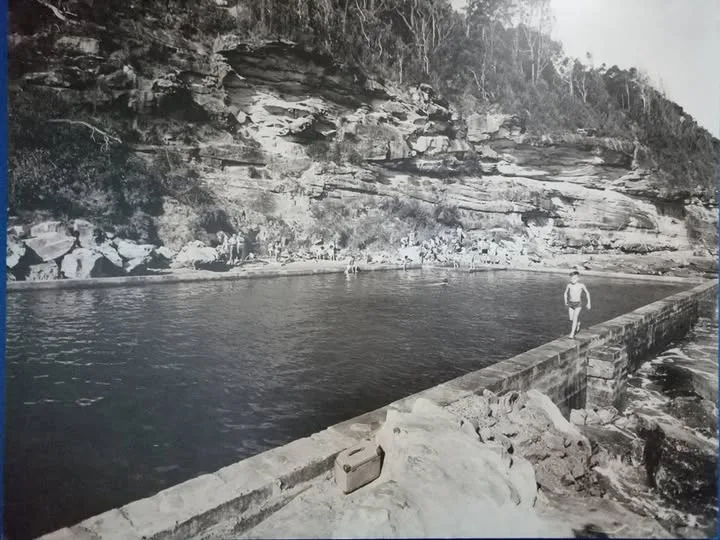
Umina Beach (ghost pool)
South Umina Tidal swimming pool was beautiful with the rock face above it but mostly destroyed in storms 1974.
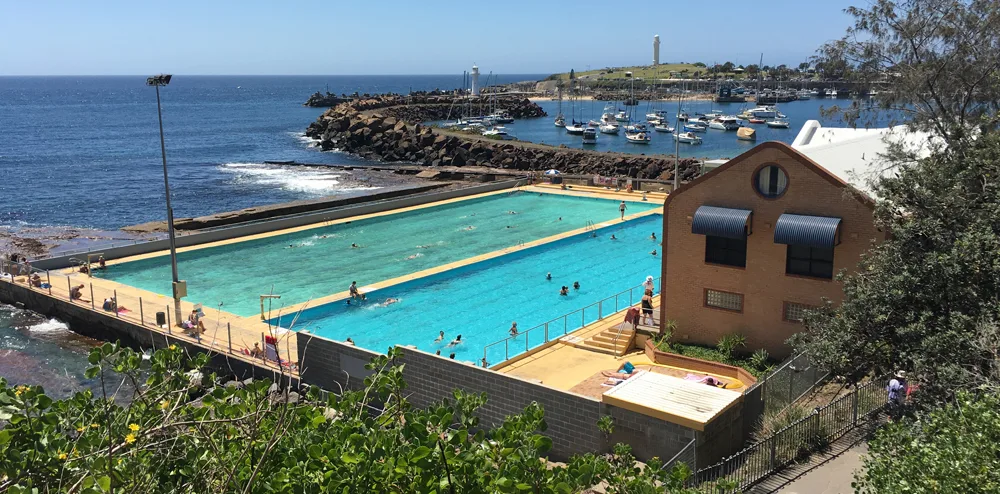
Wollongong Continental Baths (Wollongong Central Baths)
An updated version of the 1920s continental pool. This pool embodies the changing face of swimming as a skill, a sport and a recreation. This is the most recent of the set of adult-size ocean baths between North Wollongong and South Wollongong surf beaches.
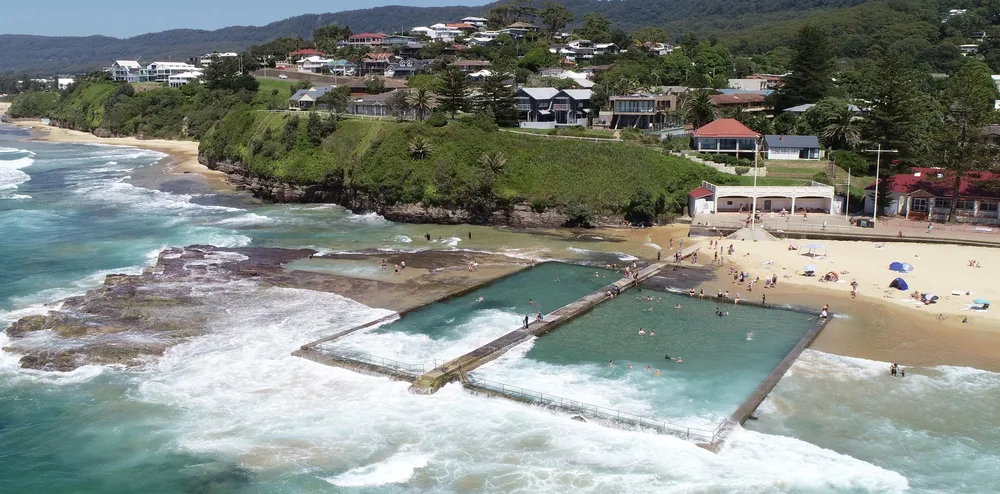
Austinmer Baths (Austinmer Rock Pools), NSW
The double pool near the surf club attracts many regular swimmers who ignore the earlier pool a little to the south. Photographers have created memorable images of this pool, which appeared on early twentieth century postcards and still appears on postcards and greeting cards.